
Improving polyester purity for chemical recycling


Within the PESCO-UP project, partners are working to overcome one of the main barriers in textile recycling: the presence of polyester (PES) and cotton (CO) in the same material. These blended textiles are widely used, but the cotton fraction disrupts the polyester recycling process, especially during high-temperature treatments, where cellulose degrades and negatively affects the quality of recycled PET (rPET).
To address this challenge, PESCO-UP is testing and improving two separation technologies: VTT’s Biocelsol process and NBG’s Aaltocell process. Once the polyester fractions are obtained through these methods, the PESCO-UP partners CuRe Technology and Centexbel analysed their purity to evaluate whether they meet the requirements for the PES recycling process. By linking these steps, the project aims to reach a polyester purity of over 99%, ensuring that both the PES and CO streams from blended textiles can be successfully recycled and reused.
Development phase
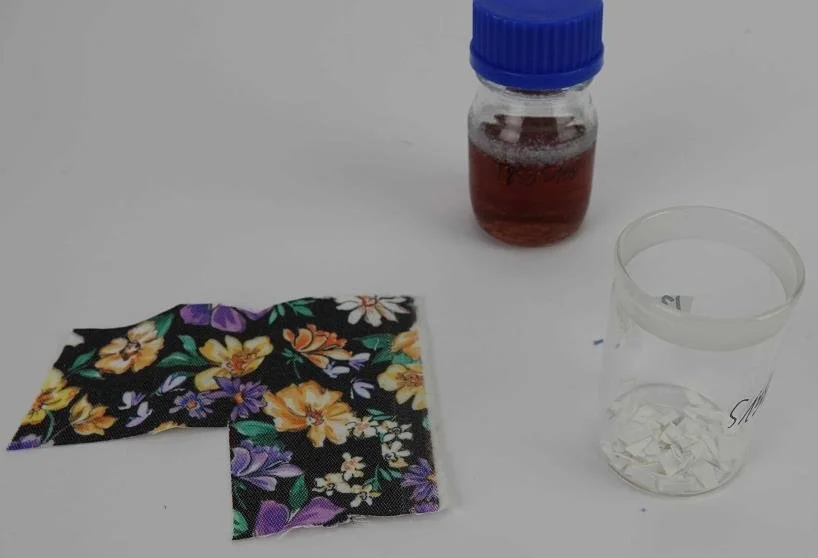
Figure 1: Original coloured sample on the left, the extraction liquid from the xylene extraction in the centre, and the uncoloured sample after extraction on the right
PESCO-UP’s approach is to separate the cotton and polyester fractions so that each material can be processed in its own dedicated recycling stream. Cotton recycling technologies can already extract the cellulosic part from mixed textiles, leaving behind a polyester-rich residue. By optimising these processes, the polyester residue can potentially be upgraded from a waste material to a valuable feedstock suitable for chemical recycling.
Currently, many polyester samples still contain a notable amount of cotton, which limits their immediate use in large-scale recycling. However, improvements are clear: while the Aaltocell process has reached a maximum purity of around 95%, one of the latest Biocelsol samples achieved 99% polyester purity, a highly promising result for further testing within CuRe’s glycolysis, purification, and repolymerisation steps.
In addition, Centexbel analysed samples from decolouration trials performed in WP3 (Figure 1), focusing on the removal of dyes and additives, another factor affecting recycling quality. These first results confirm that increasing purity is possible and that material quality is consistently improving as processes advance.
What’s next?
Both the Aaltocell and Biocelsol processes have shown clear progress in reducing the amount of non-PES material throughout the project. The next phase will focus on maximising purity levels and ensuring that these results can be consistently reproduced. Since both technologies are still operating at laboratory or pilot scale, an additional priority will be to explore possibilities for scaling up the processes, as long as the economic conditions are favourable.
In the coming months, PESCO-UP will continue refining the separation conditions and carrying out more detailed analyses of material composition, particularly focusing on how any remaining impurities could affect chemical recycling. Another important aspect will be to verify whether the highly purified PES obtained can reliably enter CuRe’s advanced recycling process. At the same time, PESCO-UP will investigate alternative uses for polyester residues that may not meet the strict requirements for chemical recycling but could still have value in other applications.
By simultaneously advancing technical purity and assessing scale-up opportunities, PESCO-UP aims to make a significant step toward achieving true circularity for polyester–cotton blended textiles.
